Deployant Clasps and Strap Sizing
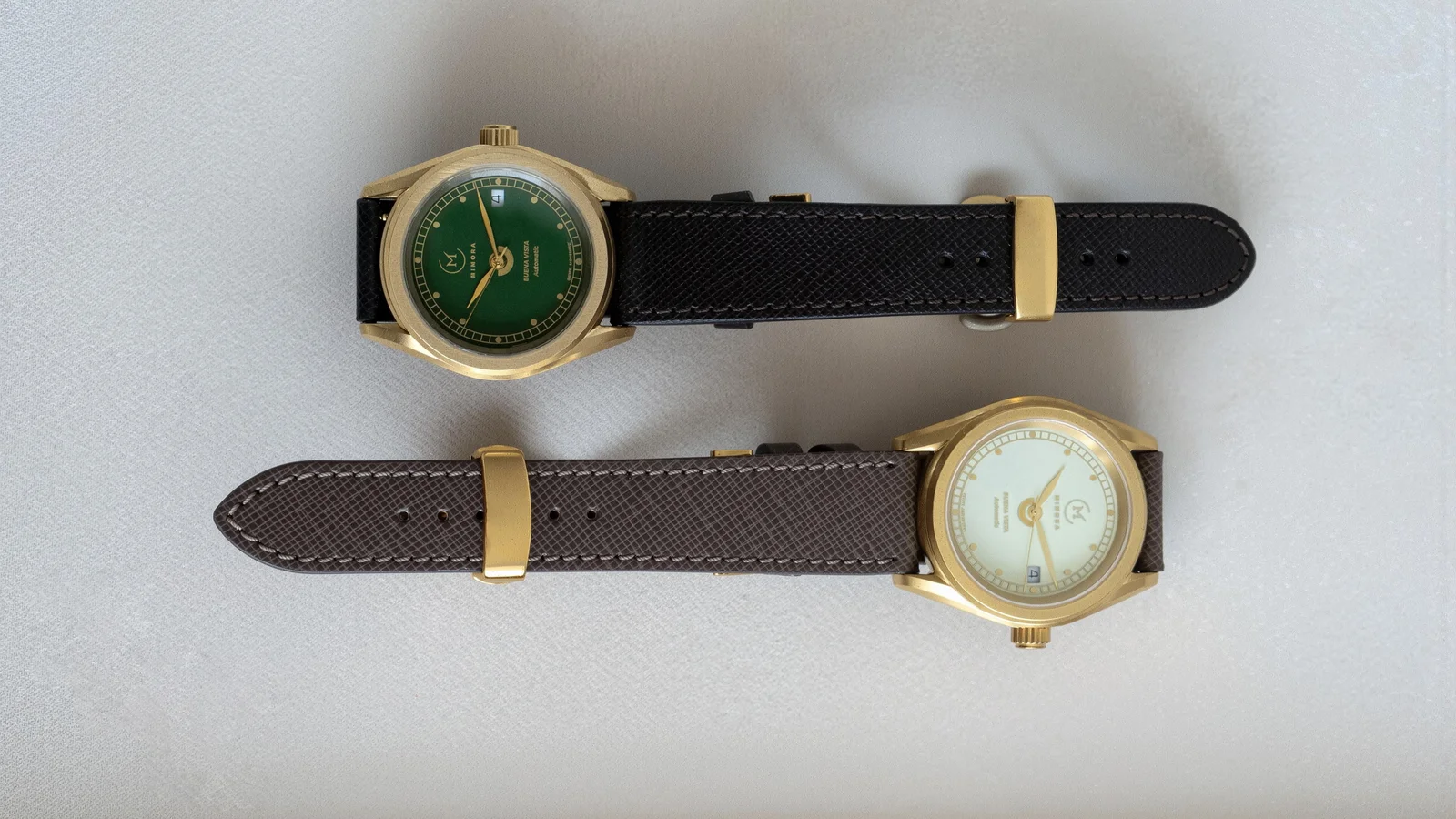
Every watch in the Debut Collection ships on a quick-release leather strap closed by a butterfly deployant clasp with push-buttons. Buena Vista, Springtide, and Voyager all share the same closure. This guide covers how that clasp works, why it treats the leather more gently than a pin buckle, how to open and close it, how to swap a strap without tools, and how to choose among the four sizes.
The Butterfly Deployant Clasp
A deployant clasp holds the strap at a fixed length. Instead of threading a tail through a buckle and a keeper each time you put the watch on, you set the fit once and the clasp folds open and shut around it.
The butterfly form is a double-fold design. Two hinged wings extend from a central spine and meet in the middle. When the clasp is closed, the wings fold inward and the strap forms a continuous loop around the wrist, with no loose tail. When it is open, both wings swing out symmetrically, and the opening doubles so the watch clears the hand.
Two push-buttons sit on the sides of the central cover. Pressing them releases the catch that holds the wings folded.
Why a Deployant Protects the Strap
On a pin buckle, the leather is bent sharply around the buckle bar and loaded at a single hole every time the watch is fastened. Over months, that one point carries most of the wear, and the tail that feeds through the keeper creases and darkens.
A deployant moves the flexing off the leather and onto the hardware. The two strap ends meet at the folding mechanism, and the steel wings absorb the repeated opening and closing. The leather is no longer pulled through a buckle or stressed at a single pin hole, so it holds its shape and finish for longer. The watch also comes off over the hand rather than being unthreaded, which shortens the handling the strap sees each day.
Opening and Closing
To open, press both push-buttons at the same time. The wings release and fold outward, and the loop opens wide enough to pass over your hand. Lift the watch away; nothing needs adjusting.
To close, rest the watch on your wrist and press the folded clasp shut until the catch clicks home. The push-buttons keep the wings closed until you press them again. Because the length stays fixed, the fit is the same each time you wear it.
Quick-Release Spring Bars
The strap sits between the lugs on spring bars, the small sprung pins that seat in the drilled holes of the case. Our straps use quick-release spring bars, so a strap can be changed without a tool.
On the underside of each strap end there is a small lever. Slide the lever toward the center of the strap to retract one tip of the spring bar. With that tip clear of the lug hole, lift the strap end away. To fit a strap, seat one tip of the bar in its hole, retract the other with the lever, guide it into place, and release. Give the strap a gentle tug to confirm both tips have seated. Do not force a bar that will not retract; check that the lever is moving freely instead.
Choosing Your Size
Each strap has a long side and a short side, and both fold into the deployant. We offer four sizes. Strap size does not affect the price, so choose by fit alone. The dimensions below are measured for a case with 35 mm between the spring bars.
S: long strap 110 mm, short strap 70 mm; wrist 153 to 183 mm.
M (default): long strap 115 mm, short strap 75 mm; wrist 163 to 193 mm.
L: long strap 120 mm, short strap 80 mm; wrist 173 to 203 mm.
XL: long strap 125 mm, short strap 85 mm; wrist 183 to 213 mm.
M is the most common fit and ships as the default. To measure your wrist, wrap a flexible tape or a strip of paper around it just past the wrist bone, where the watch sits, and read the circumference in millimeters. Where two sizes overlap, the smaller one wears closer to the wrist and the larger one leaves a little more room. The same four sizes apply to any additional strap you order.
If you fall between sizes or are unsure, write to us at contact@mimora-watches.com before ordering, and we will help you settle on the right length.