How an Automatic Watch Works
Energy From the Wrist
Every watch in the Debut Collection runs without a battery. The Buena Vista, the Springtide, and the Voyager each carry a Sellita automatic caliber, the SW200-1, the SW280-1, and the SW510 BH b, and all three keep time the same way: on energy drawn from the wrist.
This guide follows that mechanism from the rotor to the balance, then answers the two questions owners ask most, why a watch stops and how to start it again.
On the Buena Vista, the rotor and bridges are modified in our workshop. The timekeeping principles described below are the same across all three.
Winding by Wear
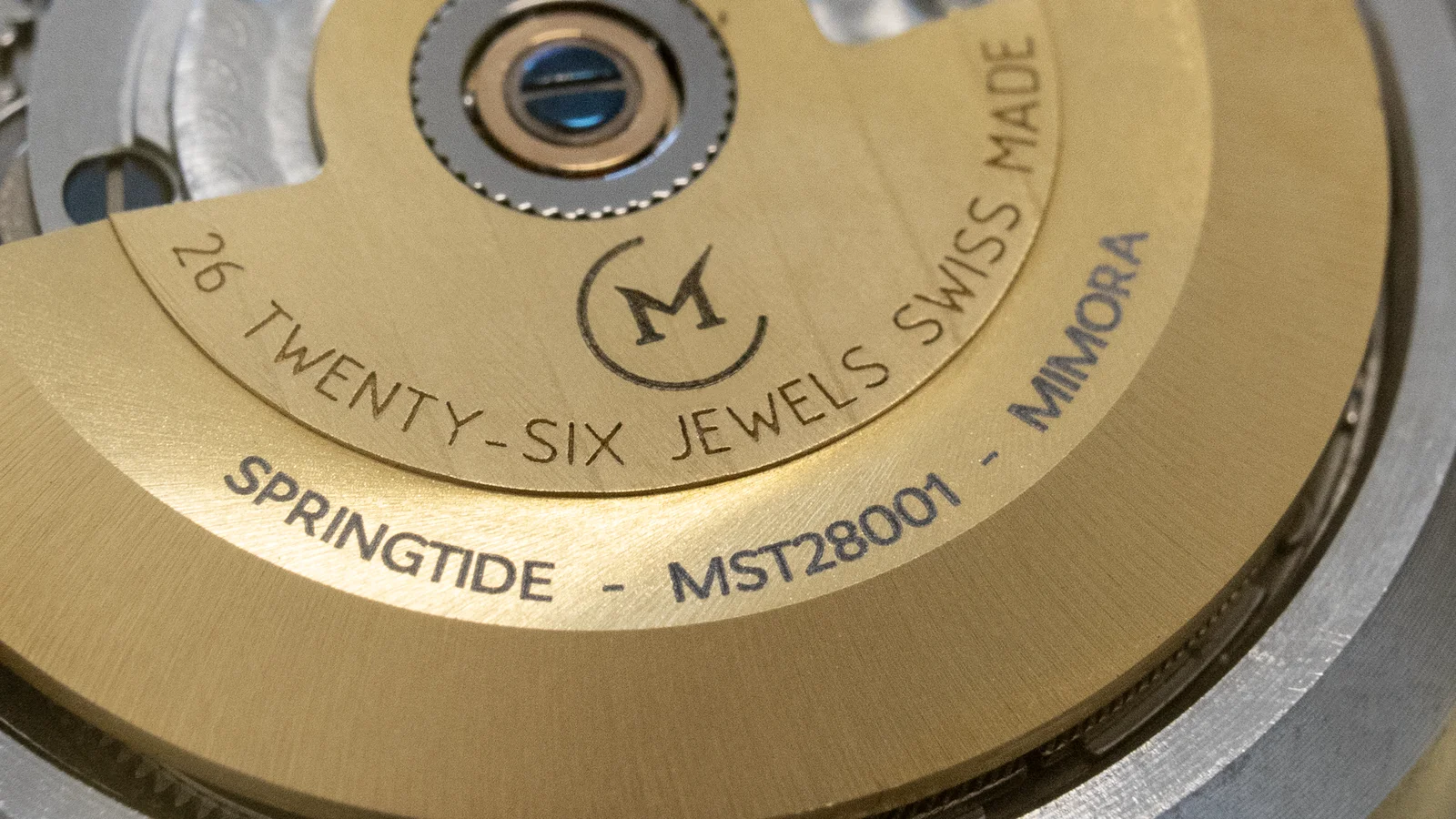
At the back of each movement sits a semicircular weight, the rotor, or oscillating weight. In all three Mimora calibers it carries a heavy-metal segment and turns on a ball bearing. As the wrist moves, the weight swings, and a train of reversing wheels captures that motion in both directions of swing, winding the mainspring a little at a time. This is what automatic means. The watch winds itself from ordinary wear.
You can also wind by hand. With the crown pushed in, at position one, turning it winds the same mainspring directly. The automatic mainspring has a slipping bridle inside the barrel, so it cannot be overwound. Once the spring is full, the bridle slips and no further tension builds.
A quiet day at a desk may not swing the weight enough to keep the mainspring full. If the watch starts to feel low on reserve, a short hand-wind in the morning tops it up.
The Mainspring and the Power Reserve
The mainspring is a coiled ribbon of spring steel. Winding tightens it, running lets it unwind, and the amount of running it can deliver on a full wind is the power reserve. These figures come straight from Sellita:
Buena Vista, SW200-1: typical 41 hours, minimum 38.
Springtide, SW280-1: typical 41 hours, minimum 38.
Voyager, SW510 BH b: typical 62 hours, minimum 56.
Worn through the day, none of them runs down. Left off the wrist past its reserve, each will stop.
The Gear Train
Energy leaves the barrel through the gear train, a set of meshed wheels that steps the power down and carries it toward the escapement. The same wheels drive the hands, which is why the watch releases its energy steadily, as measured time, rather than all at once.
The Escapement and the Balance
On its own, the mainspring would spend itself in seconds. The escapement prevents that. It is a lever, a pallet fork working against an escape wheel, that releases the gear train one step at a time, locking and unlocking in step with the balance. Each unlocking is the tick you hear.
The balance is a weighted wheel on a hairspring that swings back and forth at a fixed rate. In every Mimora caliber it beats at 28,800 vibrations per hour, or 4 Hz, which is eight ticks a second, and swings through a lift angle of 50 degrees. That steady beat is what turns stored energy into accurate time.
Jewels
Where the fastest parts meet the plates and bridges, Sellita fits synthetic ruby bearings. Ruby is hard, takes a smooth polish, and holds oil well, so friction and wear stay low across years of running. The SW200-1 and SW280-1 use 26 jewels each. The SW510 BH b, which adds a chronograph, uses 27.
Hacking
Pull the crown to its outermost position and the balance stops dead. This is the stop-second, or hacking, function, and all three calibers have it. It lets you set the watch to the second against a reference and release it exactly on the mark.
Why It Stops, and How to Restart
An automatic stops for one reason. The mainspring has run down and nothing has wound it, which usually means the watch has been off the wrist longer than its power reserve.
To bring it back:
Turn the crown in position one to wind the mainspring by hand. A full wind takes at least 27 turns on the Buena Vista and Springtide, and at least 41 on the Voyager. A dozen is enough to get it running.
Set the time, and the date or moonphase where the model has one, following the setting guide for your watch.
Put it on. Everyday movement keeps it wound from there.
There is nothing else to reset. A mechanical watch has no memory to lose and no battery to replace. Wound and worn, it keeps going.