Water Resistance, Explained
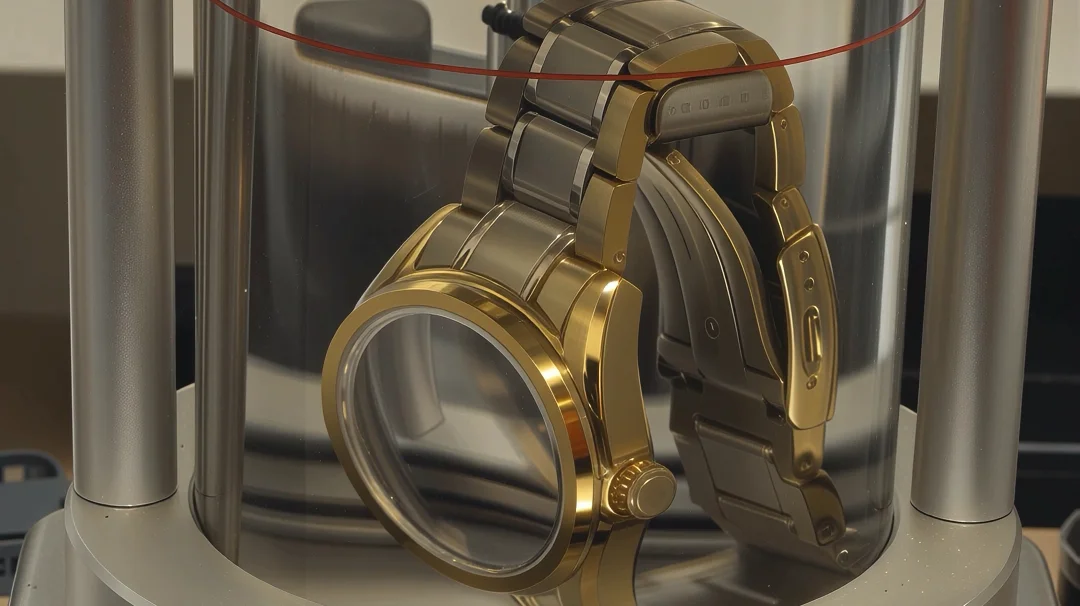
A water resistance rating is one of the most misread numbers on a watch. The figure near the caseback looks like a depth, but it describes a laboratory test, not an invitation to dive. This guide explains what the ratings on our watches mean, and how to treat each of the three watches in the Debut Collection around water.
What The Rating Measures
Water resistance is verified as a static pressure. In testing, a watch is held against a fixed pressure that corresponds to a column of still water at a given depth, and the case is checked for any ingress. A rating of 100 m means the case withstood the pressure equivalent to 100 m of still water, held steady, under controlled conditions. It does not mean the watch is built to be worn while descending 100 m underwater.
Ratings are quoted in meters or in atmospheres. One atmosphere, written as 1 ATM, is close to the pressure of 10 m of water. So 30 m is roughly 3 ATM, and 100 m is roughly 10 ATM. Both units describe the same static test, read two different ways. The point of the number is repeatability in the workshop, not a promise about the sea.
Why The Number Is Not A Depth You Can Reach
Still water in a laboratory is not the water you meet in daily life. Swimming, a wrist slapping the surface, a jet from a faucet, or the plunge of a dive all add dynamic pressure that briefly exceeds the static number. Temperature swings matter as well. Moving from a hot shower to a cold pool makes the gaskets expand and contract, and the seal is only as good as the rubber holding it in place.
For that reason, the rating is best read as a ceiling reached under ideal conditions. Everyday guidance sits comfortably below it, and that gap is deliberate. A watch worn well within its rating has a margin in hand for the ordinary shocks of a day, which is exactly how it should be used.
Splash Versus Swim
A practical reading of the two ratings that appear across our watches:
30 m is splash resistance. It covers rain, hand washing, and an accidental splash. It is not a swimming rating.
100 m is a swimming rating. It covers swimming and snorkeling, in addition to rain and splashes.
Neither rating is a license to dive with equipment, and neither belongs in a hot tub, where heat and pressure work against the seals at the same time.
The Three Watches
The Debut Collection carries two ratings across its three watches. Here is how each one is meant to be worn around water.
Buena Vista is rated to 100 m. You can wear it to swim and to snorkel, and it will shrug off rain and a splash without concern.
Springtide is also rated to 100 m, with the same guidance. Its date and moonphase are set through the crown, so make sure the crown is fully seated against the case before any contact with water.
Voyager is rated to 30 m, which is splash resistance. Do not swim with it, and do not operate the chronograph pushers near water. The pushers travel against the case, and working them in or near water is the surest way to break the seal.
Caring For The Seals
A few habits keep a water resistant watch sealed for years:
Rinse the 100 m watches with fresh water after any contact with salt water. Salt is abrasive, and it dries into the case gaps and the gasket seats where you cannot see it.
Have the gaskets checked at service. Rubber seals age, compress, and lose their spring over time. A service is when they are inspected and, where needed, replaced.
Keep the crown fully pushed in whenever the watch might meet water. A crown left out is an open door, regardless of the rating on the case.
None of this asks for special effort. A rinse, a seated crown, and a service on schedule are enough to keep a case doing its work quietly, year after year.
On The Warranty
Our warranty does not cover damage caused by exceeding a watch's rating. The numbers above are the boundary. Stay inside them, and the case is doing exactly the job it was built to do.